
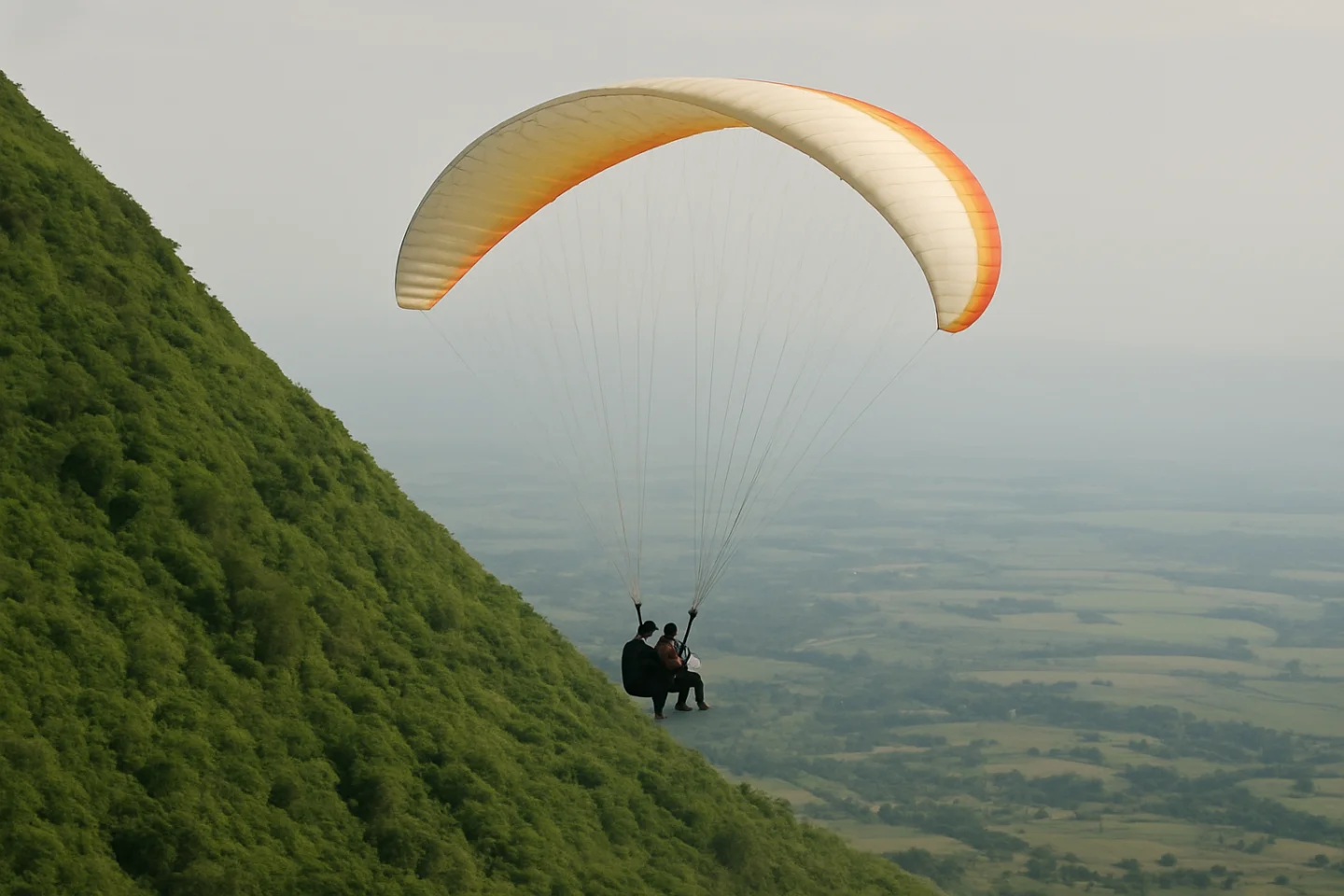
Paragliding did not begin with a single invention or originate entirely with one person. Its history spans several stages: using parachutes from slopes, organizing the first flights, developing wings designed specifically for the activity, and later expanding tandem flight.
The First Flights from Slopes
During the 1970s, some parachutists began using their equipment to launch from slopes and descend smoothly. This practice, known as slope soaring, used the shape of the hillside and the rising air currents created when wind meets terrain.
At that stage, the equipment had not yet been designed as modern paragliders. These were parachutes adapted to a new way of launching and flying. The experience gained helped identify the characteristics wings needed to inflate easily, remain stable and respond better near the terrain.
Mieussy and the Organization of a New Activity
Mieussy, in Haute-Savoie, France, holds a central place in the early history of paragliding. The place is associated with some of the first slope-soaring flights and with the organization of a pilot community that helped turn those experiments into a recognizable activity.
The early pilots and clubs connected with Mieussy helped give the activity continuity and establish a distinct form of flight. Mieussy’s importance does not mean that all paragliding emerged from one place: earlier influences and parallel developments existed elsewhere. Its role was that of a historic focal point where slope flying began to develop continuity, community and more stable organization.
From Adapted Parachutes to La Randonneuse
The next change was material. The activity gradually moved beyond relying only on modified parachutes when the first wings made specifically for slope flying were developed.
La Randonneuse, associated with Laurent de Kalbermatten and generally dated to 1985, is one of the most recognized milestones in that transition. It is considered one of the first wings produced specifically for paragliding and one of the earliest widely recognized production wings in the discipline. It should not be presented as the absolute first precursor, since earlier experiments and prototypes already existed.
A wing designed for this activity could respond to the specific needs of slope flying instead of starting with equipment created for another purpose. That specialization helped establish equipment and methods specific to paragliding.
From then on, equipment continued to evolve through improvements in design, stability and control. The modern wing grew out of this accumulation of changes and the gradual adaptation of equipment to the needs of flight.
How Paragliding Became a Sport
As equipment improved and the activity became more organized, paragliding spread beyond its early European centers. Different ways of flying also became more distinct. Recreational flying focuses on enjoying the launch, glide and landing in suitable conditions, while cross-country flying uses rising air currents to extend the flight.
Acrobatics explores advanced maneuvers and requires specific preparation. Training methods based on the controlled simulation of incidents belong to a different instructional context. A distance record, an acrobatic maneuver and a recreational tandem flight are not the same type of practice and do not require the same level of preparation.
The Expansion of Tandem Flight
At a later stage than the first slope flights, tandem flying brought paragliding to people who wanted to experience the activity without training as solo pilots. In this format, a passenger shares the wing with a qualified pilot and can experience the launch, flight and landing without becoming an independent pilot.
The growth of tandem flying separated a first contact with the sport from independent practice. That distinction remains important: enjoying a flight as a passenger and learning to pilot are different experiences, with different training needs and responsibilities.
From Paragliding’s Origins to Today
Today, tandem flying allows people to experience paragliding as passengers. Adventure Ride offers this experience in the Piedechinche / Santa Elena area of Valle del Cauca. The flight lasts between 10 and 25 minutes, depending on conditions, and the full activity takes approximately 1.5 to 2 hours.
The experience includes a briefing, equipment, medical insurance, flight, photos and HD video. Operations depend on the weather: flights take place only when conditions are suitable for carrying out the activity safely.