
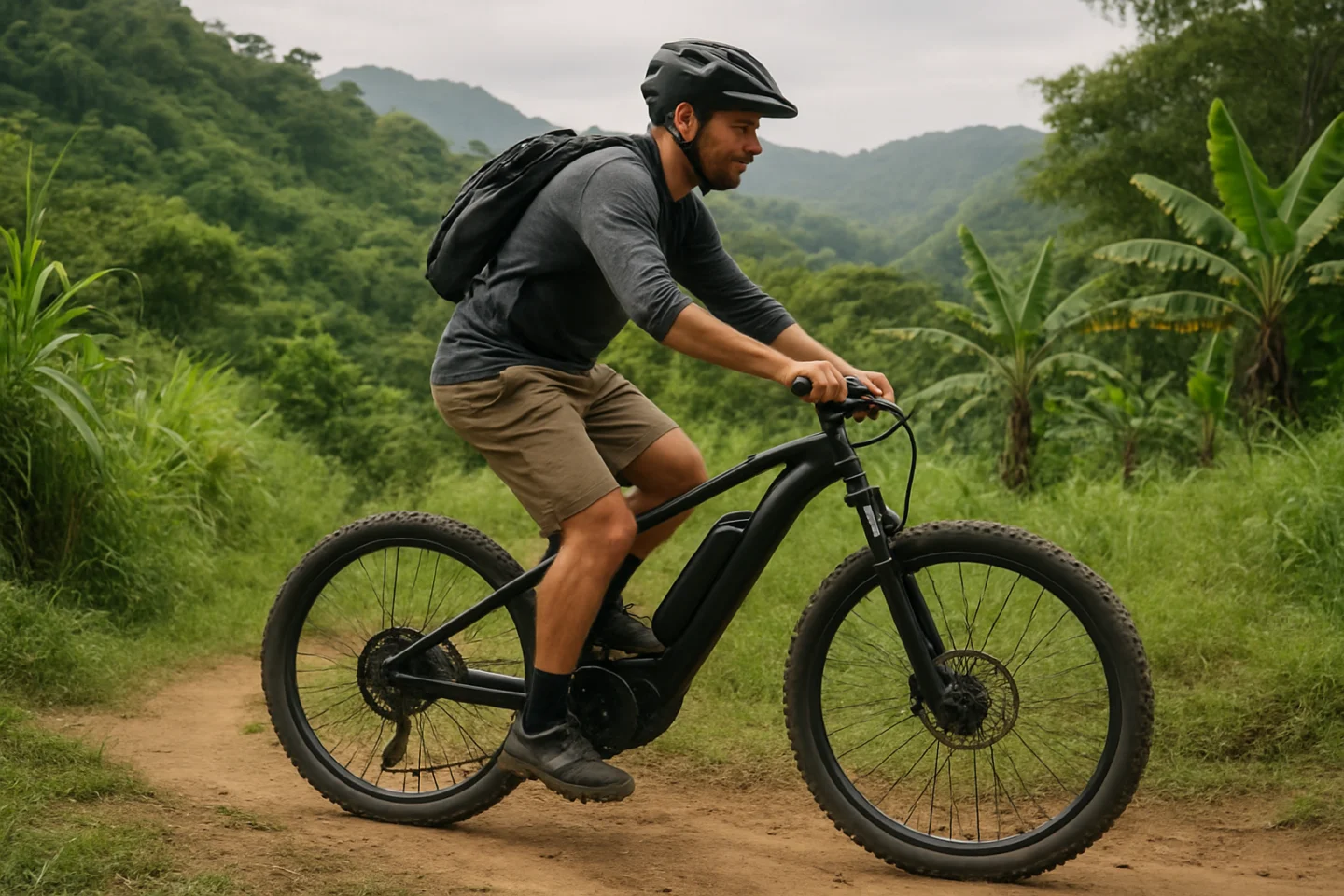
A mountain e-bike combines pedaling with electric assistance to help you travel along natural routes. The motor reduces some of the force needed, but it does not turn the activity into a passive ride or a motorcycle: balance, control, maneuvering and adaptation to the terrain are still required.
This assistance makes it easier to manage your effort during a route and can open up an active outdoor experience to people with different levels of preparation. Adventure Ride is an active-tourism business based in Santa Elena, in the Piedechinche area of Valle del Cauca, and e-bike experiences are part of its offering.
What Electric Assistance Adds
The main difference from a conventional mountain bike is the assistance that accompanies your pedaling. On a climb, a prolonged section or demanding terrain, that assistance reduces the force needed to keep moving.
The effort does not disappear. You still pedal, choose your line, maintain your balance and respond to the conditions of the route. Physical demand depends on the assistance level, terrain, elevation gain, route duration and each participant’s condition.
In practice, assistance can make the demands of a route more manageable and leave you with more energy to pay attention to the trail and enjoy the surroundings. The experience still depends on the specific characteristics of the route.
What Effort Remains During a Route
Available evidence indicates that cycling with electric assistance can reach moderate intensity, although the physiological response varies according to the route, assistance level and each person’s condition. Compared with conventional cycling, the demand is usually lower, but it remains meaningful physical activity.
Assistance can be understood as a conceptual scale:
- Low assistance: requires more active participation and maintains greater physical demand.
- Medium assistance: helps balance pedaling effort and comfort over a changing route.
- High assistance: reduces the demands of certain sections more substantially, without eliminating bike control or the need to adapt to the terrain.
These levels explain the experience in general terms and do not necessarily describe the settings available on Adventure Ride’s bikes. They also cannot be used to promise a specific improvement in strength, cardiovascular fitness or overall fitness.
Who May Find It Useful
A mountain e-bike can be especially useful for someone who wants to try mountain biking without turning the entire route into an endurance test. It can also make it easier for people with different levels of experience to share an activity and manage their effort according to their abilities.
Safety note: Before booking, confirm the difficulty, handling requirements and conditions of the specific route, as well as the terrain, elevation gain, duration, available bikes and sizes, group capacity and any experience requirements. Each participant should communicate any relevant limitations in advance.
How to Choose an Experience Based on the Route and Your Expectations
The label “e-bike” alone does not tell you how much effort a route will require. To set a reasonable expectation, consider the terrain, elevation gain, duration, available assistance and the experience needed to control a bike in a natural environment.
The El Paraíso Route is described in the available information as a more recreational and cultural route around Hacienda El Paraíso, viewpoints and waterfalls. It is an example of how an e-bike experience can combine pedaling with scenery and other elements of the route, rather than focusing only on performance.
The duration, price, capacity, inclusions, available sizes and difficulty level for this route should be checked in the current product information before booking. The same applies to any other e-bike route offered by the operation.
When an Experience May Be More Responsible Toward the Local Area
An e-bike is one form of active transportation, but using one does not automatically make a tourism experience sustainable. The impact depends on the activity and the trip as a whole.
Replacing a journey that would normally be made in a motor vehicle with a bike is not the same as adding an activity to a trip reached by car. Group size, the route, respect for trails, waste management and the relationship with local people and places also matter.
During the activity, an e-bike does not produce tailpipe emissions at the place of use in the way a combustion vehicle does. That difference alone does not demonstrate a reduction in the total footprint of the trip, which also depends on transportation to the area, manufacturing and maintenance of the bike, the electricity used and the management of its components. Staying on permitted routes, avoiding trail damage and managing waste are operational practices, not benefits guaranteed solely by the technology.
A Mountain Experience That Can Adapt Better to the Group
The value of a mountain e-bike is not that it eliminates effort, but that it allows the intensity of the route to be managed differently. That can be useful when a group includes people with different ability levels or when the goal is to combine activity, scenery and discovering the area.
At Adventure Ride, the El Paraíso Route offers a confirmed example of this recreational and cultural combination in Valle del Cauca. People comparing experiences can use it as a reference and consult the company’s e-bike category when its operating details and corresponding page have been confirmed.
The final choice should be based on the actual route and each participant’s circumstances. In this way, electric assistance is understood as a tool for experiencing mountain biking in a more accessible and considered way—not as an automatic guarantee of performance, health or sustainability.